


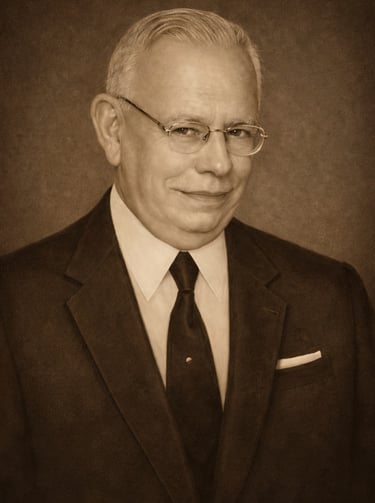
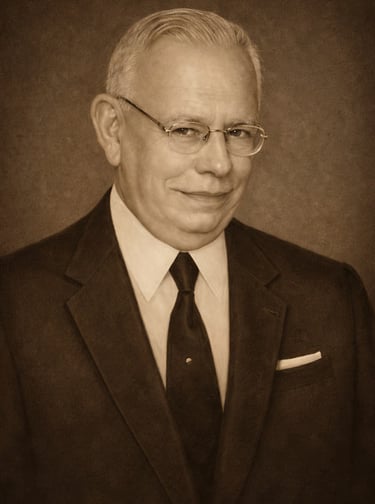
Marcos Frankenthal z"l
Marcos Frankenthal z”l, grandfather of Lilia Frankenthal, was one of the central figures in the organization of Jewish life in São Paulo: journalist, typographer, educator, Zionist leader, president of the Unified Zionist Organization and one of those responsible for building the institutions that still sustain the community today, such as the Jewish Federation of São Paulo (FISESP).
This page honors and tells the story of a man who understood, before many others, that memory is not just longing: it is responsibility. And that belonging to a community, as his granddaughter, is not merely receiving an inheritance — it is fulfilling a duty.
From Jerusalem to São Paulo: memory, responsibility and community building
Our story begins with a generation that crossed continents, raised institutions, founded newspapers, organized campaigns, welcomed immigrants, sustained schools, mobilized solidarity and understood a simple truth: a community does not stay alive just because it remembers. It stays alive because it organizes.
Marcos Frankenthal z”l, grandfather of Lilia Frankenthal, President and founder of AVIVA•18, was one of those rare men. He did not merely take part in Brazilian Jewish community life. He helped build it.
He was an educator, journalist, typographer, intellectual, orator, Zionist leader, president of the Unified Zionist Organization of the State of São Paulo, president of the Magbit and one of the decisive figures in the institutional formation of São Paulo's Jewish community in the 20th century.
His life explains much of the values that guide what AVIVA•18 is today: belonging with responsibility. Tradition turned into concrete action.
A Jew from Jerusalem who helped build São Paulo
Marcos Frankenthal was a Sephardic Jew born in Jerusalem, part of the old Jewish core of the Land of Israel — the Old Yishuv. His father, Rabbi Moshe Shlomo Frankenthal z'l, known as the Giant of the Torah, was a great scholar, respected for his intelligence and erudition.
After leaving his homeland, and before settling in Brazil, Marcos passed through several countries, especially England. This journey gave him something that would mark all of his public work: a broad view of the Jewish world, of the diaspora and of the need for organization.
On arriving in Brazil, he first settled in Rio Grande do Sul, where he taught Portuguese and Hebrew in Jewish schools linked to the agricultural colonies. Before he was a leader, he was a teacher. Before he organized institutions, he helped shape people.
These origins matter. Because Marcos Frankenthal did not see community as an abstraction. He saw it as school, newspaper, meeting, fundraising, welcome, library, printed word, physical presence and moral duty. Something old and serious, made with paper, ink and commitment — back when “engagement” was not yet a like button.
The printed word as community building
In São Paulo, Marcos Frankenthal devoted himself to journalism and the printing industry. He founded the newspaper Mosaico Paulista, set up the Tipografia Frankenthal print shop and worked in the printing trade for about fifty years.
The print shop was not just a business. It was a tool of collective existence.
In the 1920s, out of his print shop came the idea of publishing a Yiddish periodical for São Paulo's Jewish community. In 1928, he led the Idische Velt - The Jewish World - one of the first attempts to create a serious Jewish publication in São Paulo, literary, social and communal in character.
In 1931, he founded and directed the San Pauler Idiche Tzeitung, also known as Jornal Israelita de São Paulo or Gazeta Israelita de São Paulo. The newspaper, with a strong Zionist orientation, ran until 1941 and brought together prominent names of the Jewish intelligentsia, such as José Nadelman, Isaac Raizman, Elias Lipiner, Salomão Steinberg and Nelson Vainer.
There, community life was recorded. There, identity was debated. There, memory was preserved.
And for a time, the newspaper also had a Portuguese-language supplement, A Notícia, directed by his son Naum Frankenthal, then a law student. This detail is beautiful and profound: the immigrant generation spoke Yiddish; their children were beginning to speak to Brazil as well, in Portuguese. Continuity did not break with tradition. It translated tradition into the future.
His print shop also published important community works, such as the history of Ezra, preserving records that, without this effort, might have been lost. Marcos Frankenthal understood something every institution should understand: without documented memory, history turns to smoke. And smoke, let's face it, is carried off by the wind.
Unified Zionist Organization: the center of responsibility
Marcos Frankenthal was one of the great names in the post-war reorganization of São Paulo's Jewish community.
In 1945, the Zionist Organization of São Paulo was reorganized under his presidency, bringing together leaders such as Rabbi Fritz Pinkus, Horácio Lafer, Moysés Kauffmann, Jacob Klabin Lafer and Raphael Markman.
At the head of the Unified Zionist Organization of the State of São Paulo, Marcos Frankenthal did not act as a symbolic figure. He acted as a bridge-builder. As an organizer. As someone capable of turning historical pain, national hope and community solidarity into concrete structure.
At the solemn ceremony of July 31, 1945, in the Blue Room of the Cine Odeon in São Paulo, Marcos Frankenthal presided over an event marked by the memory of Theodor Herzl and by the reaffirmation of the Jewish people's right to their ancestral home. In his speech, he linked the victory of the Brazilian Expeditionary Force in Europe to the victory of justice over force, affirming the moral bond between Brazilians and Jews in the face of tragedy and reconstruction.
The central sentence of his life could be this: hope without organization is merely wishing. He organized.
FISESP: when community becomes institution
Marcos Frankenthal's work is also tied to the process that created the Jewish Federation of the State of São Paulo — FISESP.
The meeting to create the Federation took place on December 23, 1946, at the headquarters of the Unified Zionist Organization of São Paulo. From that movement onward, São Paulo's Jewish community began to structure its activities in a more centralized and rational way: welfare, fundraising, receiving refugees, welcoming new immigrants, education and community representation.
This point is essential to understanding the importance of Marcos Frankenthal.
He did not merely preside over an organization. He helped design an institutional model. FISESP was born of the need to coordinate scattered efforts and give public form to collective responsibility. São Paulo's Jewish community needed more than generosity. It needed organization. It needed method. It needed institutions capable of weathering crises, welcoming people and speaking on behalf of a community.
This line of leadership and commitment would also be carried on by his son-in-law, Raphael Markman, a figure equally tied to São Paulo's community life.
Some families leave property. Some families leave names. The Frankenthal-Markman family also left a way of serving: building institutions so that the community need not depend solely on the goodwill of the moment.
Magbit, campaigns and concrete solidarity
Marcos Frankenthal also presided over the Magbit, playing a central role in fundraising campaigns and community mobilization.
This work reveals a permanent mark of his leadership: solidarity, for him, was not a decorative feeling. It was organized duty.
Fundraising was not “asking for money”. It was building trust. It was showing that each person was part of a larger network. It was turning belonging into practical responsibility.
A community only stays standing when each person understands that they are not merely inside it — they are committed to it.
1948: sobriety in the face of Israel's independence
In 1948, with the proclamation of the State of Israel and the immediate outbreak of war, Marcos Frankenthal showed rare lucidity.
On the morning after independence, when many might have been swept up in euphoria alone, he called the community to responsibility. His message was sober, hard and profoundly Jewish: it was not yet time simply to celebrate. It was time to sustain, protect, organize and act.
“There is no room for joy yet. Jewish blood is being shed.”
That sentence sums up his greatness. Marcos Frankenthal understood that Jewish joy has never been naive. It has always lived alongside responsibility, memory and duty.
At that moment, his leadership helped turn emotion into action: campaigns, material support, public mobilization, community support and moral backing in a delicate international scenario.
It was also in this context that he was invited to serve as Consul of Israel in São Paulo. He declined.
Declining does not diminish his importance. On the contrary: it reveals his independence. Marcos Frankenthal chose to remain on the community's front line, free to mobilize, coordinate and serve without the constraints of diplomatic protocol. Some people need a title to have authority. Others have authority precisely because they do not need the title.
Family as continuity: Naum, Leonardo and Lilia
Marcos Frankenthal's legacy did not end with him.
His son Naum Frankenthal took a direct part in the Jewish press, directing the Portuguese-language supplement A Notícia, linked to his father's newspaper. His work symbolizes the passage between worlds: from the Yiddish-speaking immigrant community to a Jewish-Brazilian generation able to speak Portuguese as well, to engage with the country and to preserve its identity without isolation.
His son Leonardo Frankenthal, father of Lilia Frankenthal, carried forward another strand of this heritage: the word as an instrument of defense, responsibility and public courage. As a criminal defense lawyer, Leonardo became known as the Lion of the Courts. In him, the courtroom was also continuity: the same respect for the word, the same firmness in the face of injustice, the same conviction that certain causes demand voice, skill and courage.
His granddaughter Lilia Frankenthal, Leonardo's daughter, has devoted herself to fighting antisemitism since October 7, 2023. As hate speech against the Jewish community spread, and with it the need for organization, AVIVA•18 was born in 2025.
From Marcos to Naum, Leonardo and Lilia, there is a clear thread: memory is not ornament. It is a mandate.
“You have fulfilled your duty as a Jew”
A small receipt signed by Marcos Frankenthal, as president of the OSU in 1948, holds an immense sentence:
“You have fulfilled your duty as a Jew.”
At first glance, it looks like just an administrative document. But it is not. It is a declaration of belonging.
This sentence expresses an ancient and powerful idea of Jewish life: we are responsible for one another.
Duty, here, does not appear as a cold imposition. It appears as a moral commitment. As a call to solidarity. As a reminder that belonging to a community does not mean merely receiving a history, a name, a tradition or a memory. It also means caring, sustaining, supporting and being present.
This receipt speaks of giving. But above all, it speaks of responsibility.
And, deep down, it speaks of something universal: when a community recognizes that every life matters, that every family matters, that every wounded person matters, it becomes stronger than fear, older than hatred and more resilient than indifference.
Why this legacy matters to AVIVA•18
AVIVA•18 was born as an independent association for prevention, education, protection and accountability in the face of antisemitism, racism and hate speech.
But it was also born as continuity.
Marcos Frankenthal organized a community in times of reconstruction, war, immigration and uncertainty. AVIVA•18 organizes knowledge, protocols, guidance, support and institutional response in a time of new codes of hate, new forms of dehumanization and new threats to Jewish life.
The tools have changed. The principle remains.
Back then it was newspapers, print shops, assemblies, synagogues, campaigns and in-person meetings. Today it is reports, guides, training, legal action, education, digital monitoring, advocacy and victim protection.
But the logic is the same: feeling is not enough. We must act.
Remembering is not enough. We must protect.
Reacting to hate is not enough. It must be interrupted.
AVIVA•18 honors Marcos Frankenthal and carries forward his teaching that a strong community is not the one that shouts the loudest. It is the one that organizes best. It must have a voice, independent of governments, conveniences and the historical moment.
Memory that protects
This page is a family, community and institutional tribute.
Family, because Marcos Frankenthal z”l was Lilia Frankenthal's grandfather.
Community, because his work helped consolidate institutions that still sustain organized Jewish life in São Paulo and in Brazil today, such as the founding of FISESP in 1946.
Institutional, because his legacy points to the future of AVIVA•18: turning memory into responsibility, responsibility into action, and action into protection.
Jewish history has never been made of survival alone. It has been made of reconstruction. Of unity.
Marcos Frankenthal rebuilt with words, ink, school, newspaper, campaign, institution and presence.
AVIVA•18 follows that path.
Because honoring the past means carrying forward what it entrusted to us.
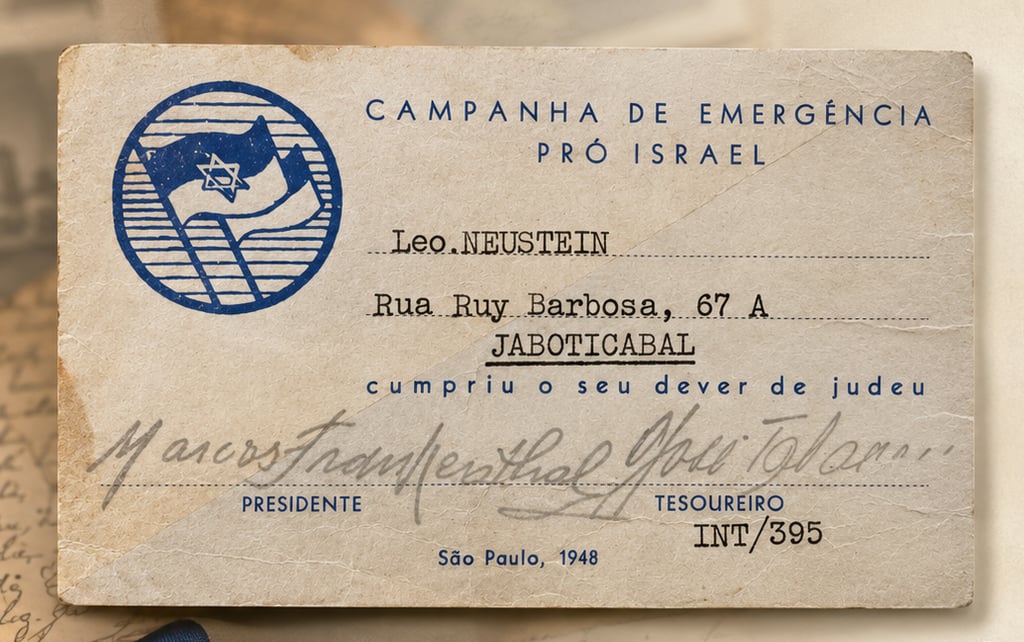

Receipt from the Pro-Israel Emergency Campaign — São Paulo, 1948, signed by Marcos Frankenthal z"l.
You have fulfilled your duty as a Jew
More than a sentence, it defines one of the community's core values: we are responsible for one another.
Our unity is our strength, for more than 5,000 years
The invisible becomes visible. Knowledge that protects.
Fighting hate takes method, presence and institutional courage.
Contact
Phone: +55 11 5225-8418
WhatsApp: +55 11 5225-8106
E-mail: aviva18@aviva18.org.br
ZIP code: 04543-011 - São Paulo, Brazil
(C) 2026 AVIVA18 - Independent association. Method and institutional courage from day one.